I'd like to interrupt our regularly scheduled programming to give my thoughts on this weekend's tournament. Those of you who lament the lack of an item spotlight should tune in to Mondays with Monte tonight at 8:00 PM CST, where I'll be discussing Season 3 items and showcasing a few of them in replays.
IPL5 was a grueling, four day affair which tested the endurance of the players, and tested the K-Pop tolerance of the viewers. As the final tournament before the cataclysmic Season 3 changes, IPL5 delivered with some of the best teams in the world. There were pentakills, breathtaking plays, upsets, and surprises. It was a fantastic tournament.
While much will change in Season 3, there is at least one lesson we can learn from this tournament which will undoubtedly still be relevant in the days ahead. It's an obvious one, but nevertheless is often forgotten. League of Legends is a game of information warfare.
This isn't about secret strategies and cheeses that teams jealously guard against, but the actual game itself. From champion select to the late-game, the flow of information dictates much of what happens. Teams with information and knowledge of their opponents can act confidently, making plays and dominating a match. Those without struggle, toil, and often lose. It's a story that was told multiple times over the course of the weekend, but never more clearly than the final day of play.
For a simple yet never before seen example, consider Fnatic's Evelyn and Shen combination in their third and last series against TPA. During Fnatic's final push TPA could not know where Evelyn was. If she was still with the bulk of her team, initiating on them would only have invited a Shen ult and defeat. But if she was with Shen anyone who went to stop his split push would have no chance of success. Evelyn's quantum state cowed TPA, ultimately leading to Toyz' demise and Fnatic's victory.
On a grander scale we can look to the grand finals themselves. In game 2 Fnatic had a commanding lead against WE, but eventually lost. What turned the game around for WE was superior map control. When WE realized that Fnatic had lost Oracle's without replacing it, and were also skimping on wards, WE went ward crazy. With Fnatic's jungle lit up like a Christmas tree the plays that had been dominating WE stopped working, and WE used their superior information control to make plays which would normally have been very risky. Many of sOAZ's deaths were the result of Fnatic ceding information control to WE. By the time they realized what was going on and bought a new Oracle's, WE had already taken the lead by a large margin and the game was all but over.
The final match of the grand finals demonstrated what Fnatic should have done with that lead. WE took a strong early advantage, grabbed an Oracle's, and denied Fnatic as much information as possible. Behind and without any way to see WE's plays coming, Fnatic struggled in their attempts to catch up. While they held the gold deficit steady for a time, eventually the lack of information control caught up with them and WE's lead exploded. It was a textbook example of how the unknown can force a team into a situation where their only option is to fall further and further behind.
Denying your opponent information, forcing them to make assumptions, and then defying their assumptions to catch them by surprise are core principles for everything from laning, to jungling, to champion select, and to overarching team strategy. Even with the upcoming nerf to Oracle's and the proliferation of wards thanks to Sightstone, the control of information will continue to be a critical part of League of Legends.

Showing posts with label wards. Show all posts
Showing posts with label wards. Show all posts
Monday, December 3, 2012

Sunday, July 15, 2012
Thought: Pink Wards
Pink wards are highly underrated as a form of early map control. Up until Oracle's starts appearing pink wards are an excellent way to limit enemy vision. For junglers especially a well placed pink ward can lead to important opportunities.
The hardest part of ganking for a jungler, particularly in the side lanes, is enemy vision. Wards typically block the most accessible and successful gank routes. While you can often gank around these obstacles, the psychological pressure that results from blinding your opponents can give your allies an advantage even if you never gank.
Currently the only popular place to pink ward is Dragon. It's a very safe, high value choice that your opponents will want warded. Very often a jungler or support will pink ward this location in order to establish control over Dragon and open up the river gank path. Even at higher Elos it's rare for an opposing support to have a pink ward handy, and if they do they have to worry about leaving their ally alone or being ambushed while they ward. While arguably the best place for a pink ward, Dragon is not the only place where they are potentially valuable.
Pretty much any location where the opponent must ward in order to fend off ganks or counter-jungling is a viable place for a pink ward. The hard part is tracking where wards are being placed. It's relatively easy to make educated guesses if you have decent vision of your opponents, or if you place your wards first. The key is coordinating with your jungler (or the lane if you are the jungler) to take advantage of a pink ward.
That's the ultimate answer of why pink wards aren't more common. That level of coordination is more effort that more solo queue players are willing to give, and often the players you try to coordinate with are unresponsive. Still, in ranked 5s you should practice tracking wards and countering them with pink wards, the payoff can be immense.
The hardest part of ganking for a jungler, particularly in the side lanes, is enemy vision. Wards typically block the most accessible and successful gank routes. While you can often gank around these obstacles, the psychological pressure that results from blinding your opponents can give your allies an advantage even if you never gank.
Currently the only popular place to pink ward is Dragon. It's a very safe, high value choice that your opponents will want warded. Very often a jungler or support will pink ward this location in order to establish control over Dragon and open up the river gank path. Even at higher Elos it's rare for an opposing support to have a pink ward handy, and if they do they have to worry about leaving their ally alone or being ambushed while they ward. While arguably the best place for a pink ward, Dragon is not the only place where they are potentially valuable.
Pretty much any location where the opponent must ward in order to fend off ganks or counter-jungling is a viable place for a pink ward. The hard part is tracking where wards are being placed. It's relatively easy to make educated guesses if you have decent vision of your opponents, or if you place your wards first. The key is coordinating with your jungler (or the lane if you are the jungler) to take advantage of a pink ward.
That's the ultimate answer of why pink wards aren't more common. That level of coordination is more effort that more solo queue players are willing to give, and often the players you try to coordinate with are unresponsive. Still, in ranked 5s you should practice tracking wards and countering them with pink wards, the payoff can be immense.
Tuesday, April 24, 2012
Jungling: Warding
In a duel between junglers, wards are supreme. A jungler's ability to gank, counter-jungle, and control the map are largely dictated by where each team has placed wards. Knowing where to place wards and where the enemy has placed theirs is critical to the role of a jungler.
It's the uncertainty that junglers bring to a game that makes wards so important. Simply by being shrouded in the fog of war a jungler exerts pressure, curbing offensive action by forcing opponents to second guess whether engaging is safe. Any information that allows you to know or estimate the position and intention of the enemy jungler is extremely valuable.
From just one small piece of information you can infer many things. For example, consider a level 2 gank. By ganking so early a jungler reveals not only their position but that they have yet to clear half their jungle. An enterprising opponent will therefore beeline for the undefended jungle, punishing the ganker. The enemies in other lanes can also rachet up their aggression as they know they are safe. Simply by knowing a jungler's location a team gains a significant advantage.
With that in mind, here are some important ward locations:
Location #1: Wraiths

Warding the enemy's wraiths is possibly the single best investment a jungler can make. Because wraiths are the easiest camp the clear, the fastest to respawn, and centrally located a ward placed there is extremely likely to spot the enemy jungler. It also allows you to know if wraiths are available to be stolen, and provides early warning if someone is coming to stop your counter-jungling. You shouldn't ward your own wraiths unless it's too dangerous to ward a more advantageous location.
Location #2: Opposite from Wraiths
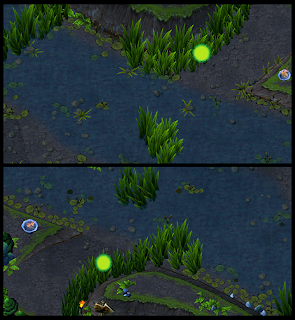
Any time you go to ward your own wraiths, think about warding here instead. These locations provide more information by also covering most of the river, protecting mid from jungle ganks, and protecting sidelanes from roaming opponents. The wards still cover the entirety of the ramp leading to wraiths, so it is impossible for an to sneak by them (without stealth).
With both locations 1 and 2 warded the most convenient paths for enemy junglers to counter-jungle are closed off. If you warded these locations first you can also guess when and if the enemy is placing similar wards. Combined with wards from top and bottom lanes it becomes impossible for the enemy jungler to leave their jungle unnoticed.
Location #3: Dragon

This is typically your support's responsibility, but in solo queue you can't guarantee that they'll consistently keep it warded. I've marked a few spots because dragon wards largely depend upon your side, blue or purple, and where your other wards are located. Pink wards, however, should almost always go in the marked spot. There are very few useful dragon ward locations which can't be seen from that spot.
There are many other good warding spots, but as a jungler these three are the most critical. With wards in these locations it becomes much easier to control the enemy jungler and their jungle. It's remarkable how much can be done when you know something as simple as the location of the enemy jungler.
It's the uncertainty that junglers bring to a game that makes wards so important. Simply by being shrouded in the fog of war a jungler exerts pressure, curbing offensive action by forcing opponents to second guess whether engaging is safe. Any information that allows you to know or estimate the position and intention of the enemy jungler is extremely valuable.
From just one small piece of information you can infer many things. For example, consider a level 2 gank. By ganking so early a jungler reveals not only their position but that they have yet to clear half their jungle. An enterprising opponent will therefore beeline for the undefended jungle, punishing the ganker. The enemies in other lanes can also rachet up their aggression as they know they are safe. Simply by knowing a jungler's location a team gains a significant advantage.
With that in mind, here are some important ward locations:
Location #1: Wraiths

Warding the enemy's wraiths is possibly the single best investment a jungler can make. Because wraiths are the easiest camp the clear, the fastest to respawn, and centrally located a ward placed there is extremely likely to spot the enemy jungler. It also allows you to know if wraiths are available to be stolen, and provides early warning if someone is coming to stop your counter-jungling. You shouldn't ward your own wraiths unless it's too dangerous to ward a more advantageous location.
Location #2: Opposite from Wraiths

Any time you go to ward your own wraiths, think about warding here instead. These locations provide more information by also covering most of the river, protecting mid from jungle ganks, and protecting sidelanes from roaming opponents. The wards still cover the entirety of the ramp leading to wraiths, so it is impossible for an to sneak by them (without stealth).
With both locations 1 and 2 warded the most convenient paths for enemy junglers to counter-jungle are closed off. If you warded these locations first you can also guess when and if the enemy is placing similar wards. Combined with wards from top and bottom lanes it becomes impossible for the enemy jungler to leave their jungle unnoticed.
Location #3: Dragon

This is typically your support's responsibility, but in solo queue you can't guarantee that they'll consistently keep it warded. I've marked a few spots because dragon wards largely depend upon your side, blue or purple, and where your other wards are located. Pink wards, however, should almost always go in the marked spot. There are very few useful dragon ward locations which can't be seen from that spot.
There are many other good warding spots, but as a jungler these three are the most critical. With wards in these locations it becomes much easier to control the enemy jungler and their jungle. It's remarkable how much can be done when you know something as simple as the location of the enemy jungler.
Subscribe to:
Posts (Atom)